🎉 Nagomi Visit has a new name: Borderless Visit.
Our mission remains the same, connecting people through home-cooked meals and genuine encounters.
Learn more
I Visited a Japanese Family Near Osaka — Here's What Actually Happened | Borderless Visit
Today we're sharing a guest story from Ting, a Taiwanese traveler who has spent nearly a decade living in Japan and now calls Sweden home. She joined Borderless Visit as a guest for the first time, and here's what happened — in her own words.
Guest Story · From Taiwan · Visit near Kansai, Japan
Why I signed up
I've lived in Japan for close to ten years. The country is familiar to me in a lot of ways. But there's a difference between knowing a place and truly understanding how people actually live there.
What I've always looked for, whether traveling or living abroad, is that kind of real exchange: sitting across from someone, learning how they see things, and walking away with a perspective you didn't have before. Borderless Visit felt like exactly that kind of opportunity. Not another itinerary. Just a real home, and a real conversation.
What happened when I submitted my request
Within a few hours of submitting my request, I had received two separate invitations. Both hosts had taken the time to write genuinely warm messages: introducing who they were, a little about their family, and why they wanted to welcome me. I ended up choosing the host who had a personal connection to Taiwan, which felt like a good sign right from the start. Reading those messages, even before we'd met in person, I already felt at ease. It felt like being invited by someone who genuinely wanted to meet me, not just receive a guest.
Once we matched, we started messaging directly. We introduced ourselves properly and figured out together what we'd cook on the day. My host is learning Chinese, so our conversations naturally shifted between Chinese, Japanese, and English. Part language exchange, part getting-to-know-you — all before we'd even met in person.
How the booking process works
Step 01
Submit Your Request
Fill in your available dates and introduce yourself. Once you submit, host families within roughly an hour's travel will be able to see your request and reach out. I was lucky: within eight hours, I had two invitations in my inbox.
Step 02
Choose Your Host
Look through the profiles and messages from hosts who've invited you, and choose the one that feels right. I confirmed my match within 24 hours.
Step 03
Complete Your Booking Within 72 Hours
Each invitation expires after 72 hours with no extensions, so once you've decided, complete the booking to secure your visit. The cost is 6,000 yen per adult (approximately 37 USD). Children aged 5–12 are 4,000 yen, and children under 5 join for free.
Step 04
Keep in Touch Until the Day
Once matched, you can message your host directly to sort out the details and share any food preferences. By the time the day comes, you already have some sense of each other.
Step 05
Meet and Enjoy
Your host will be waiting for you at the nearest station. From there, just follow their lead into the neighborhood, their home, and whatever the afternoon brings.
The visit itself
My host, Mihorin, lives near Kansai International Airport. It was raining on the day, and she drove to the station to pick me up.
We'd talked beforehand about what to cook, and I'd mentioned I was living in Sweden and wanted recipes I could actually make at home. Mihorin took that seriously. She prepared the menu in advance and even prepared the instructions in Chinese. We cooked together that afternoon, and I came away with recipes I actually still use.
She also made douhua (豆花) from scratch — a classic Taiwanese dessert, soft silken tofu served warm or cold in a light sweet syrup. It was her way of making something personal.
Looking back, that detail still stands out to me. She hadn't just planned a menu; she'd thought about what I would actually do with it after I went home. The Chinese instructions, the choice of dishes, the way she'd made the whole afternoon feel like something prepared just for me. It's the kind of care you don't expect, and don't forget.
Where the Real Conversation Happened
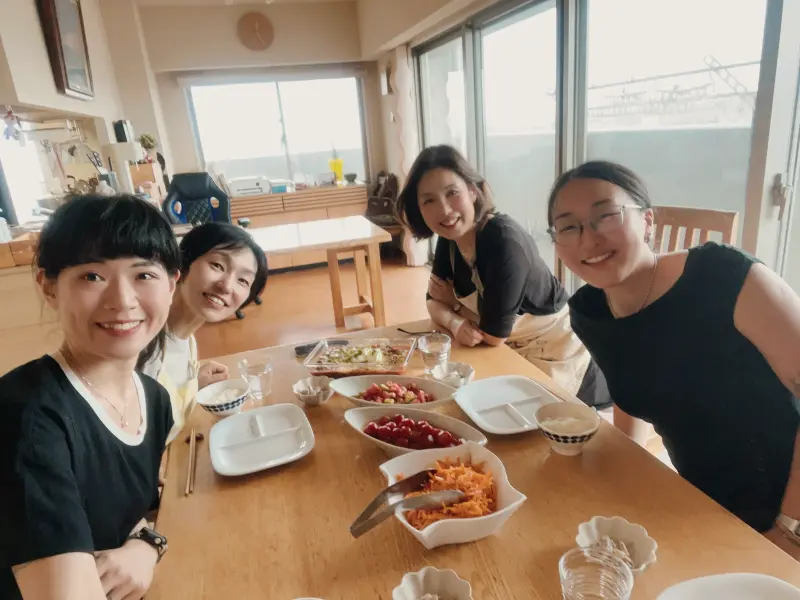
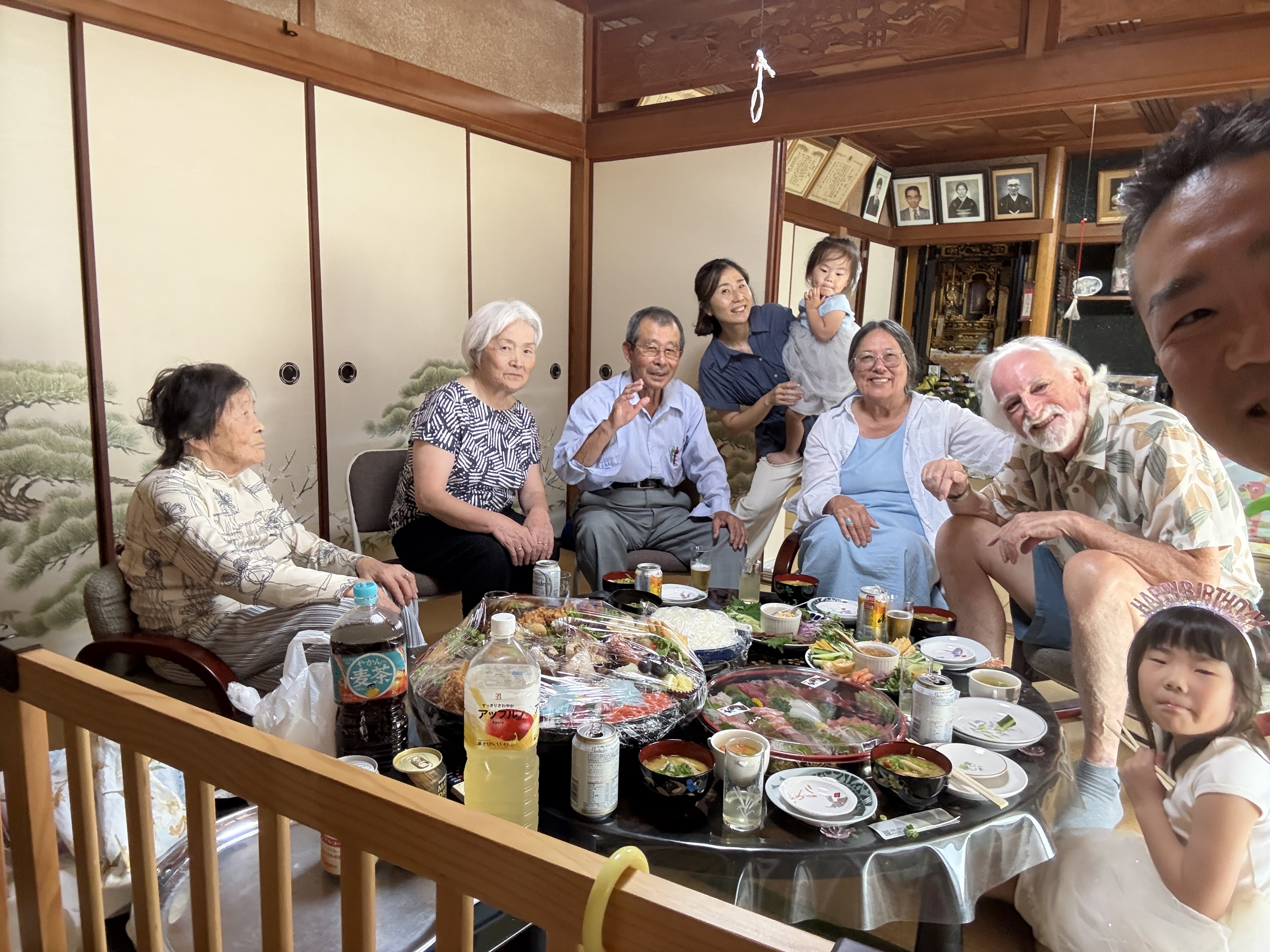
She had two friends over as well: a Japanese mother, and a woman who'd grown up in Europe with Japanese roots. The four of us cooked, ate, and ended up talking for hours.
About cultural differences between Japan, Taiwan, and Europe — the unwritten rules, the social habits, the things that feel normal in one place and quietly confusing somewhere else. About living between countries, the small adjustments you stop noticing after a while, and the things that still catch you off guard years in. About food, family, and the everyday things you never think to explain until someone from somewhere else asks. The kind of conversation where everyone has something to share, and everyone walks away with something new.
I left that afternoon with a few more people I'm genuinely glad to know.
I got there at 11. When I checked the time, it was past four. I had a plan for the rest of the day, so I had to leave. But I wasn't ready to.
What's happened since
Mihorin and I stayed in touch. Her son has plans to study in Taiwan, so she connected us, and the three of us now share a group chat. It started as a meal and turned into something that still goes on.
What surprised me most wasn't the food or the conversation —
it was how natural it all felt, like meeting someone you were somehow always going to get along with.
Who I'd recommend this to
If you're going to Japan and you want the standard itinerary, this probably isn't for you. But if you're the kind of person who ends up spending an hour at a local supermarket because it's interesting, or who finds yourself more curious about the neighborhood than the landmark, it's worth trying. You pick your host, they pick you back, and you see what happens.
Common Questions
What to Expect from a Borderless Visit
Is it awkward visiting someone's home you've never met?
Less than you'd think. The messaging before the visit helps a lot. By the time you arrive, you already have some sense of who you're meeting. Most guests find the awkwardness, if there is any, disappears within the first few minutes.
What do you actually do and talk about?
It depends on the host. In my case, we cooked together and talked about living between countries, food, family, and everyday life. Your host is genuinely curious about you, which makes conversation easier than you might expect.
Can you tell your host what you want to do or eat?
Yes. I mentioned I was based in Sweden and wanted to learn dishes I could actually make at home. My host planned the whole afternoon around that. The more context you give beforehand, the more personal the experience tends to be.
How long does it usually last?
A few hours, typically. Mine went to five without feeling like it. The pace is relaxed and there's no fixed end time.
Do people stay in touch with their hosts afterwards?
Some do. I did. Whether a friendship continues depends on the people involved, but it's not uncommon. The visit itself creates enough of a real connection that it sometimes carries over naturally.
About Borderless Visit
More Than a Meal. A Genuine Connection.
Borderless Visit connects travelers with Japanese host families for an evening of authentic Japanese home dining. Not a restaurant, not a tour, but a real meal in a real home with people who are genuinely curious about you.
Every Japanese family experience through Borderless Visit is different, but the heart of it stays the same: a real connection with people who want to know you, even briefly.
Gyoza, Typhoons, and a 3-Year-Old Who Reads English | Eboni's Borderless Visit Story
"This is the best way to experience Japan like a local and not a tourist," Eboni says at the start of her video. She wasn't exaggerating. What followed was an afternoon of folding gyoza under a host mom's careful instruction, four full plates of dumplings, a surprise summer festival, and strawberry candy sticks eaten on a park bench as the day wound down.
Guest Story · Yokohama Area
4 years in Japan · From the USA · 2nd Borderless Visit
Eboni has been living in Japan for four years and studying Japanese for ten. Somewhere in there, she found herself wanting something specific: a real connection with a local family, not just another sightseeing trip.
The Family Behind the Front Door
Waiting for Eboni was a family of four: Saori, who speaks English and Chinese and has a love for the outdoors; her husband; their curious three-year-old son who is obsessed with animals and trains; and two Chihuahuas who, according to the family, love being around people and sharing meals. It was exactly the kind of household that makes a Borderless Visit feel less like a program and more like walking into someone's actual life.
The afternoon centered around homemade gyoza, with Saori teaching Eboni how to fold the dumplings properly. By the time everything was fried up, there were four full plates of dumplings on the table, and all of it disappeared.
Dogs, Storybooks, and a Surprise Summer Festival
The afternoon wasn't just about food. Eboni played with the family's two dogs and read an English storybook to her host's young son. The three-year-old understood far more English than Eboni expected, turning the storybook into a small, genuine language exchange.
Later, the group stepped outside and stumbled into a local summer festival they hadn't planned for, picking up strawberry candy sticks and ending the day on a park bench. None of it was scheduled. All of it became part of the visit.
Eboni's Honest Take
Looking back, Eboni says her favorite part of the visit was simply trading stories with the family, swapping tales of their own travels both within Japan and abroad. What stuck with her most was how genuine the whole thing felt, especially since she and her host were able to move easily between English and Japanese without it ever feeling like a barrier. When asked if anything could have gone better, she didn't have much to add: nothing she wished she'd known beforehand, nothing she'd have changed.
Between the gyoza, the unplanned festival, and an unexpectedly bilingual three-year-old, Eboni's visit turned out to be exactly what she'd hoped for: a real connection with a local family.
"Yes, because this is an awesome way to make connections in Japan, and hopefully have people to visit next time you come."
— Eboni, on whether she'd recommend Borderless Visit
About Borderless Visit
More Than a Meal. A Genuine Connection.
Borderless Visit connects travelers with Japanese host families for an evening of authentic Japanese home dining. Not a restaurant, not a tour, but a real meal in a real home with people who are genuinely curious about you.
Every Japanese family dinner through Borderless Visit is different, but the heart of it stays the same: a real connection with people who want to know you, even briefly.
Ready for Your Own Story?
Every host family is different. Every meal is made for the people coming. Find the experience that feels right for your trip.
Ask anyone who has visited more than one Japanese family, and they will tell you the same thing: each one was completely different, and each one was wonderful in its own way. That is what makes Borderless Visit so special. Every host has their own story, their own kitchen, their own way of welcoming you in.
Guest Story · United Kingdom
7 visits · 7 cities
Paul from the UK did not stop at one. By the end of his trip through Japan, he had sat at seven different dining tables, in seven different homes, across seven different parts of the country. And when asked to compare them, he found he simply couldn't.
"Everyone is different. Every single visit has been different in every way," he said. "So if you want to experience more, you gotta do more."
In Kyoto, his host put him at ease almost immediately. They started joking around early, which set the tone for the whole evening. When her friend joined them later, the relaxed atmosphere carried right through. In Hiroshima, his host invited a neighbor over: an art teacher who turned out to be a fascinating conversationalist, and who gave Paul a book of her work before the evening was over.
Then there was Takamatsu. A mother, two daughters, laughter from the moment he walked in, origami, paper cranes, and a piano. One of the daughters had learned the entire UK national anthem — and eventually got Paul to sing it. "I can't believe she learned the whole national anthem just like that," he said. "That was cool."
"I can't say one was definitely better than any other. They have all been absolutely brilliant."
— Paul, traveler from the United Kingdom
One of Paul's most unexpected observations had nothing to do with people. It was about the food. "The biggest surprise for me was no two meals were the same. Miso soup was a popular thing, but even then it was different in every place. They would put different things in it." Seven bowls of miso soup. Seven different versions. That detail, more than anything, captures what it means to visit more than one host.
Guest Stories · Netherlands & Hong Kong
First-time visitors · 2 visits each
Both were visiting Japan for the first time. Both booked two Borderless Visits. And both came away wishing they had booked more.
The guest from the Netherlands had heard that getting into a Japanese home wasn't easy for travelers. Finding Borderless Visit felt like a solution to that. He booked two visits in two different cities, and by the time his trip was over, the thing he regretted most was not booking a third.
"It were two very, very nice hosts. They were real different from each other. That makes my experiences so much completer, richer. Three or more would have made it even more complete for me."
— Guest from the Netherlands
The guest from Hong Kong was traveling solo, and he approached his two bookings deliberately. He chose one host near Shinjuku, right in the center of Tokyo, and a second host in a quieter, non-tourist part of the city. Same city, completely different experience.
"I met host just living near Shinjuku. I see the life in the very center of Tokyo, the food, the house, the lifestyle of modern Japanese people," he said. His second visit brought him to a family home in the suburbs:quieter, more settled, with homemade sashimi and a couple genuinely curious about his life in Hong Kong.
"I met people in different ages, from different backgrounds, living in different parts of the city. The more you visit, the more you know about Japan."
— Guest from Hong Kong
Guest Stories · Germany & United States
The pattern holds across guests from different countries, different travel styles, and different numbers of visits. Here is what two more guests had to say.
Guest from Germany · 3 visits
"The good thing about doing more than one visit is the chance to meet even more new people and make maybe more new friends. And also try different foods. But I admit, while the food was always delicious, it was secondary to meeting my hosts."
First-time visitor to Japan
Guest from the United States · 3 visits
"I was able to visit three separate homes in three very different areas, places that I would otherwise have no reason to visit. Mari, Shizu, and Mari were all very, very nice. The meals and time I shared with them are among the most enjoyable experiences I have had in Japan."
Visited Japan 6 times
About Borderless Visit
More Than a Meal. A Genuine Connection.
Borderless Visit connects travelers with Japanese host families for an evening of authentic Japanese home dining. Not a restaurant, not a tour, but a real meal in a real home with people who are genuinely curious about you.
Every Japanese family dinner through Borderless Visit is different. Some involve kimono dressing and elaborate spreads. Others are quieter, more intimate: a kitchen conversation and a bowl of fruit.
For travelers looking for an authentic Japan experience beyond the standard itinerary, dining with a Japanese family offers something no guidebook can: the chance to be welcomed into someone's actual life, even briefly, and to leave having understood a little more about both Japan and yourself.
Your First Visit Is Just the Beginning.
Your first experience is already on its way. Why not explore hosts in another city while you wait?
Real Stories from Real Travelers | Borderless Visit
The best moments in Japan are rarely the planned ones. They happen at a kitchen table, over a plate of handmade sushi, when someone laughs at something that doesn't quite translate, and you understand each other anyway. These are three of those moments.
Story 01 · Tokyo
Kimonos, Mochi, and a Meal to Remember: A Family's Dinner with a Japanese Family in Tokyo
Most memorable: Dressing in kimonos
The evening didn't start at the dinner table. It started with a kimono. Before a single dish was served, Kevin and his family found themselves dressed in traditional Japanese garments, laughing and posing for photos with their host family. It was the kind of moment you don't find in a guidebook.
From the moment they arrived, there was no awkward silence, no sense of being tourists on display. Instead, they were welcomed as guests: dressed up, pulled into the warmth of a family home, and made to feel genuinely at ease. For a family traveling through Japan for two weeks, this was already shaping up to be something special.
Then came dinner. Their host family had prepared a spread that reflected the full depth of Japanese home cooking : sushi, soba, skewers, and an array of dishes that arrived at the table without easy English names. The meal finished with mochi and homemade ice cream, a detail that stuck with Kevin long after the evening ended.
"Everyone in my family thought this was the best experience in Tokyo."
— Kevin, traveler from the United States
Around the table, the conversation flowed naturally. Kevin's family talked about life in America; their hosts talked about life in Japan. They compared travel stories, swapped perspectives on everyday challenges, and found common ground in the things that tend to be universal: what people enjoy, what they struggle with, what makes a good life.
Kevin and his host are still in touch on social media, a small but telling detail. An evening that began as a cultural exchange turned into something more like a genuine friendship, the kind that crosses time zones and persists after the trip is over.
Story 02 · Regional Japan
A Silk Kimono and a Banquet: One Traveler's Deeply Personal Evening in a Japanese Home
Most memorable: A mother's silk kimono
Some experiences leave a mark before you even have the words for them. For Shireen, that moment came when her host invited her to wear a kimono. Not a rental, not a prop, but a beautiful silk kimono passed down from her host's own mother, given on her 20th birthday. Shireen was given the privilege of wearing it for the evening.
The night had begun with her host and a friend collecting Shireen and her companion from the train station, taking a detour to a nearby lookout point for a view of the region before arriving at a traditional Japanese home. The welcome was immediate and warm.
Dinner was a generous spread: sashimi, sushi, salad, chicken, vegetables, and a crepe cake, accompanied by plum wine. But what Shireen describes most is the conversation: her host's day, her work, her family, her own travels to Shireen's home country. By the end of the evening, Shireen had walked away with a list of local recommendations for the days ahead.
"Borderless Visit gives a unique opportunity to do something real and make a genuine connection during a visit to Japan. I think it is a great concept — I wish there was something similar everywhere."
— Shireen, traveler from Australia
There is something specific about being welcomed into a home, especially one where the objects on the shelves and the food on the table carry personal history. Shireen's evening was that kind of experience: not a performance of Japanese culture, but a genuine invitation into it.
Story 03 · Japan
Busy Moms, Google Translate, and a Food Bank: What an Afternoon in a Japanese Home Really Looks Like
Most memorable: Meeting her host's world
Shari came to Japan partly for her son, who is planning to move there the following year. She wanted to understand what ordinary life actually looks like. Not the temples and the tourist trails, but the everyday rhythm of a regular family. What she found was a busy mom who felt, in many ways, just like home.
Her host had a full schedule, the kind that leaves little room to spare, and yet she made the time. They talked for what felt like hours, covering everything from work and children to husbands and daily routines. When the language gap became too wide, they turned to Google Translate and kept going. "It seems that busy moms are the same everywhere," Shari observed. And that, in itself, turned out to be the discovery.
Midway through the afternoon, her host went to collect one of her children from a local food bank, and Shari came along. She met her host's friends, who were immediately curious about the visitor from New York. The idea of sharing everyday life across cultures made sense to people living it.
Dinner was a home-cooked meal: sushi, soup, fried chicken, rice, and a small bowl of fruit for dessert. Simple, careful, and made for a guest.
"The whole visit was terrific. Despite being half a world apart, I found that we were very similar."
— Shari, traveler from New York
Shari's booking didn't go entirely smoothly at the start. She missed the initial confirmation window due to a travel delay, but the Borderless Visit team stepped in and made the connection happen anyway. Sometimes things go sideways, and what matters is how they're handled.
About Borderless Visit
More Than a Meal. A Genuine Connection.
Borderless Visit connects travelers with Japanese host families for an evening of authentic Japanese home dining. Not a restaurant, not a tour, but a real meal in a real home with people who are genuinely curious about you.
Every Japanese family dinner through Borderless Visit is different. Some involve kimono dressing and elaborate spreads. Others are quieter, more intimate: a kitchen conversation and a bowl of fruit. What they share is the absence of a script. You're not a customer. You're a guest.
For travelers looking for an authentic Japan experience beyond the standard itinerary, dining with a Japanese family offers something no guidebook can: the chance to be welcomed into someone's actual life, even briefly, and to leave having understood a little more about both Japan and yourself.
Ready for Your Own Evening?
Every host family is different. Every meal is made for the people coming. Find the experience that feels right for your trip.
Being yourself is key at a Borderless Visit. The host has already read about you through the request you sent, and excited to meet you so there is actually nothing to worry about. Just figure out how to get to your host’s place using Google Maps, or your hosts can definitely help. Make sure to get there on time and be hungry.
However, since this may be your first time going to a Japanese home, you might be a little bit nervous being out of your element so here are a few tips to prepare yourself for your big day.
1. Contact your host before the Borderless Visit
Email or use your messaging app to contact your host before the Borderless Visit. Getting to know your host before meeting always makes the Borderless Visit experience more meaningful for everyone. Check in with them to figure out directions but also, don’t forget to simply share how excited you are to meet them. Communication is key to an enjoyable Borderless Visit
When preparing an emergency contact
Inform yourself of free wifi services available all across Japan. Buy a sim card for your phone in case there is no wifi available nearby. You can also rent phones or wifi routers at the airport. Make sure you provide the host with an emergency contact number or messaging app account that goes directly to you and not your travel agent.
2. Come hungry
Though the hosts are not put under pressure to cook any more than what they can manage during their busy schedules, many are very eager to go the extra mile so you will be able to get a full experience. So make sure to come hungry not only so you won’t miss out on all the delicious food but as a host, a clean plate is just always nice to see.
3. Be on time
Remember that punctuality is important. Unless a host recommends otherwise, take the train instead of buses or taxis when meeting your host since trains are almost always on time. Keep in mind that trains depart and arrive exactly on the minute their schedules promise, so if your host recommends you get on the train that departs at 17:23 it will most likely depart exactly at that time so make sure to arrive before that so you can get on that train.
4. Say hajimemashite! (hah-gee-may-mah-she-tay) with a smile when you meet your host at the station
It means “nice to meet you” and is a greeting used when you meet someone for the first time. Saying a greeting in Japanese might help to break the ice. Don’t worry if you pronounce the phrase incorrectly, it’s the thought that counts.
5. Refer to the host profile to strike a conversation
The walk from the station to your host’s home is your first opportunity to talk with your host. This might be a good time to refer to the host’s profile to strike a conversation so make sure to read the “Your Borderless Visit booking is complete!” email you got from us before the Borderless Visit.
6. Practice the art of taking off your shoes
You may already take off your shoes at the front door in your own home but give the Japanese-way a try. When you enter your host’s home, you may notice that the room’s floor level is higher than the entrance level. The trick is to try your best to place your feet on the floor level right after you take your shoes instead of the entrance level. It might be hard to balance yourself so placing your bags on the floor level before taking off your shoes will help. If your host happens to have slippers prepared, then slip them on. Some travel guides talk about bare feet not being acceptable unless you are a close friend but don’t worry too much about these sorts of details as you are hopefully going to become good friends with your host. What is important is to enter your host’s home with respect and clean feet!
7. Ask if your host needs help
Some hosts might feel it’s rude to have you help as you are their guest, but if you are interested in seeing how they are preparing the food, just ask and most likely your host will be delighted to share.
8. Bring some props to foster conversation
A few digital photos of your hometown, work, hobbies, or local cuisine will make for great conversation. Remember that the host really wants to get to know you so don’t be shy about sharing because that is what a Borderless Visit is all about.
9. Say itadakimasu before you start eating
Before you start eating, your host will most likely signal you to say in unison, itadakimasu (ee-tah-dah-key-mahss) which means “thank you for the food.”
10. Remember a few rules of etiquette while eating
There is no specific order to eat
Unless you are eating a full course meal at a restaurant, most of the time there is no specific order in which you need to eat your food. Yes sometimes it might be better to try more flavorful or fattier foods last but this has more to do with keeping your taste buds sensitive to the distinct flavors than etiquette. Another example might be when you are making food at the table which happens a lot in Japanese cuisine, like hot pot for instance. The order in which you put the various ingredients has more to do with starting with the ones that take more time to cook. However, the one exception is the shime or finish. Rice or noodles always usually goes in last in the remaining broth so you can fully enjoy the amazing bowl of umami flavor.
Pick up your bowl to eat
If your host has prepared rice and miso soup, remember to try and pick those bowls up with one hand and eat with your chopsticks in the other hand. Sipping is okay when it comes to miso soup but when eating rice, use the chopsticks to bring the rice towards your mouth. Don’t worry too much because the rice will be sticky enough for this to be surprisingly easy. Don’t pick up the other plates or bowls.
Communal plates
A lot of guides say not to take food from the communal plate with your own chopsticks but this actually depends on the host so just ask. You can also tell if they have serving utensils already prepared. If you want to try an advance way, then flip your chopsticks around and try using the top end to pick up the food from the communal plates.
Chopstick etiquette
Yes you may have read somewhere to not pass food from chopstick to chopstick, and to not stick your chopsticks upright in your bowl of rice, but don’t get too stressed out with all the rules. Just Hungry has a great post about the details so if you want to learn more, read through everything before your Borderless Visit. Just remember, the visit itself is a time of learning too so the host won’t be offended if you make any mistakes. Just do your best.
11.Slip in this one Japanese word while eating
Just remember, oishii (oy-she)! If you think something is delicious, just say it.
12. Say gochiso-sama deshita once everyone has finished eating
When you see that everyone is full and has stopped eating, saying gochiso-sama deshita (goh-chee-soh-sah-mah-day-shee-tah) and for the advanced, adding a oishi katta desu to express how delicious the food was will make your host smile!
13. Gifts are of course great but not a requirement
You probably read somewhere that gift-giving is essential in Japanese culture, and although some of that is true, remember, on a Borderless Visit, none of our hosts expect you to give them gifts. They are excited to meet you, so your stories and photos are already a gift.
However, if you want to bring a gift, any snacks from your hometown, or you may think of something your host might like after reading their profile.
You may have heard of specific rules of etiquette, such as not bringing any chrysanthemum flowers since they are only for funerals; it is the thought that counts, so don't worry so much about offending your host.
14. Don’t hesitate to ask questions
Your Borderless Visit is your chance to ask questions. Jot down all your observations or questions if you know you will forget. They may not know the answer but it will always be a good conversation starter and you both might learn something from the experience.
15. Have fun
This one is a no-brainer but wanted to remind you just in case. Yes, etiquette is always good but coming to the Borderless Visit ready to communicate, listen, and share is probably more important so get ready and have fun!
If you ever have any questions or concerns feel free to contact your host or the Borderless Visit team anytime!
For a safe and comfortable Borderless Visit experience for everyone
During the booking process, you may see a message asking you to complete
identity verification.
This step is part of Borderless Visit’s ongoing efforts to create a safe, respectful,
and welcoming environment for everyone involved.
Why is identity verification required?
A Borderless Visit experience is not a typical travel activity.
It is an experience where you visit someone’s home and share a meal together.
Because of this unique setting, we believe that feeling safe and at ease is essential
for both guests and hosts.
Identity verification helps reduce uncertainty and allows everyone to focus on enjoying
the experience itself.
Identity verification for guests
Guests are asked to complete identity verification once, before their first payment.
Simply follow the on-screen instructions
No complicated steps are required
The process usually takes just a few minutes
Once completed, you will not need to verify again for future bookings
Hosts are verified as well
To ensure fairness and mutual trust, hosts also complete identity verification
before welcoming their first guest.
Both guests and hosts go through the same process, helping create a shared sense of
trust and confidence on both sides.
How your information is handled
Identity verification is conducted using a trusted external verification service.
Your ID images and personal information are not visible on Borderless Visit
Borderless Visit does not store or manually review your ID documents
Only the verification result is reflected in the system
Your privacy and security are carefully protected throughout the process.
A small step toward better experiences
At Borderless Visit, we believe that meaningful connections grow when people feel
comfortable and respected.
Identity verification is not about control or surveillance.
It is a small step toward creating an environment where more people can confidently
enjoy the Borderless Visit experience.
Thank you for your understanding and cooperation.
We look forward to welcoming you!
Arigato, thank you for your interest and participation in Borderless Visit.
We’d like to let you know that our office will be on a short break over the New Year holiday. Please see the details below:
Holiday Closure
Our operations will be paused from December 30, 2025 through January 2, 2026.
We’ll be back to our regular schedule starting January 3, 2026.
If you contact us during the break, we’ll get back to you as soon as possible after we return, replying in the order messages are received.
For guests with bookings during the holiday period, we’ll share a separate guide with tips on what to do in case you need help regarding your visit.
Thank you for your patience and support. We hope you have a joyful and peaceful holiday season!
Whether you’ve shared a meal through Nagomi Visit before, or you just heard about us from a friend who said “you should check this out,” welcome!
We’re so glad you’re here — and we have some exciting news to share.
We’d like to let you know an important update regarding the future of Nagomi Visit.
Starting November 25, 2025, Nagomi Visit will be rebranded as Borderless Visit. This change will include updates to our name, logo, and participation fee.
What Will Change
1. New Name: From Nagomi Visit to Borderless Visit
Since September 1, 2025, Nagomi Visit has been operated by BORDERLESS HOUSE Corporation (
see our previous announcement here
). As part of the BORDERLESS HOUSE family, our new name reflects a renewed commitment to creating even more opportunities for meaningful cross-cultural connection.
2. New Logo:
Our website and materials will feature an updated design.
Our new logo symbolizes the idea of “borderless” connections, where people come together around a shared table across countries and cultures. The globe-inspired design and warm colors express a world connected through everyday exchanges such as sharing meals, stories, and experiences across cultures. The mark also carries the spirit of continuity, as it evolves from the familiar Nagomi Visit logo to represent the next chapter of our journey.
3. Participation Fee:
The participation fee will be revised for payments made on or after November 25, 2025, as follows:
Category
Current Fee (until Nov 24)
New Fee (from Nov 25)
Ages 13 and over
5,500 yen
6,000 yen
Ages 5–12
4,000 yen
4,000 yen
Ages 0–4
Free
Free
The new fee will apply only to payments made on or after November 25, 2025.
Payments completed before that date will remain unchanged, and no additional charge will be required.
What Will Stay the Same
The experience itself remain unchanged. Participants will continue to enjoy the same experience of connecting with local hosts over a home-cooked meal in a Japanese household, with the same booking process as before.
At the heart of Borderless Visit, our mission will also remain unchanged. We will continue to create meaningful moments for both guests and hosts, helping to reduce the prejudice and indifference that often come from misunderstanding. We believe that these small yet genuine exchanges can lead to a more open and connected world.
The same team members who have managed Nagomi Visit will continue to operate Borderless Visit, ensuring a smooth transition and consistent support for all our guests and hosts.
Looking Ahead
We are deeply grateful to everyone who has supported Nagomi Visit, including our wonderful guests, hosts, and partners, over the years.
We look forward to welcoming you into this new chapter as Borderless Visit, where new encounters and friendships will continue to grow beyond borders.
We’d like to share an important update regarding the operations of Nagomi Visit.
Starting September 1, 2025, Nagomi Visit will be operated by BORDERLESS HOUSE Corporation.
The Nagomi Visit team will continue working together under this new structure, and there will be no changes to our services, the booking process, or fees. If you already have a reservation, it will go forward just as planned.
The only change is that from September 1, BORDERLESS HOUSE Corporation will become the data controller. BORDERLESS HOUSE Corporation will manage your personal information in line with current laws and maintain the same high security standards we have always followed. If you have any questions about how your personal information will be handled, please feel free to contact the Nagomi Visit team directly.
A Message From Our Founder
Hello! I’m Megumi Kusunoki, Founder of Nagomi Visit.
Since launching Nagomi Visit in 2011, we’ve welcomed more than 10,000 travelers from around the world (as of August 2025). Each of them joined a Nagomi Visit to connect with locals over a home-cooked meal in a Japanese household, and through these experiences, many wonderful friendships have been formed. These meaningful experiences were made possible thanks to the warm support of our wonderful hosts and curious, open-minded guests.
From day one, we’ve asked ourselves: How can people from different cultures and languages build real connections?
We gradually built a simple system where anyone could participate by opening their home and sharing a meal from the same pot.
Our mission has always remained the same. We aim to create meaningful moments for both guests and hosts, and to help reduce the prejudice and indifference that often come from misunderstanding. We believe that continuing these kinds of exchanges can bring about small but genuine change.
In recent years, especially after the COVID-19 pandemic, we’ve been exploring new ways to grow this initiative in a world where divisions feel even more present.
To build a stronger foundation and open up more opportunities for travelers and locals to come together, we’ve made this important move. We’re excited about what lies ahead and hope you’ll look forward to this next chapter of Nagomi Visit with us.
New Operating Company (from September 1, 2025)
BORDERLESS HOUSE Corporation
2F, 1-10-8 Yanagibashi, Taito-ku, Tokyo, Japan
Representative Director & CEO: Seiichi Lee
Thank you for being a part of the Nagomi Visit community. We look forward to welcoming you not just to a shared table, but into the everyday lives of our hosts. We hope you’ll enjoy the unique connections that come from this experience.
[My hosts] were such welcoming hosts from the moment they picked us up at the train station! Together, we went to the supermarket and got fresh fish to make rolled sushi together, and some traditional Japanese sweets to snack on. It was my birthday that day, and when we arrived at their house there were decorations hung up, and they even had a birthday cake for me — it was such a kind gesture and made the day even more special.
What did you talk about during your Nagomi Visit?
During the afternoon, we discussed our trip in Japan so far and where the family travelled to during their holidays. [My hosts] had welcomed many visitors, including old friends from university abroad and new people through Nagomi Visit. I come from Ireland, and my friend from Argentina, so we discussed our lives back home, the differences in schooling systems between our countries, typical foods, and other interests. [My host] works as an engineer for Canon, and I was happy to show him my analog camera and take some film photos of the couple (although it's a Pentax!).
What did you eat?
We had so much fun preparing rolled sushi and gyoza together — the fish from the supermarket was so fresh, and the gyoza were delicious! They had also prepared some other traditional dishes to enjoy with our meal.
Do you still keep in touch with your host?
We decided to try Nagomi Visit so that we could connect with and learn about Japanese culture through the people themselves — it ended up being much more than that! I still keep in touch with [my hosts] through Facebook, and will definitely be dropping in the next time I find myself in Japan. Thank you for your kind hospitality! Matane :)