🎉 Nagomi Visit has a new name: Borderless Visit.
Our mission remains the same, connecting people through home-cooked meals and genuine encounters.
Learn more
Blog
2012-05-27
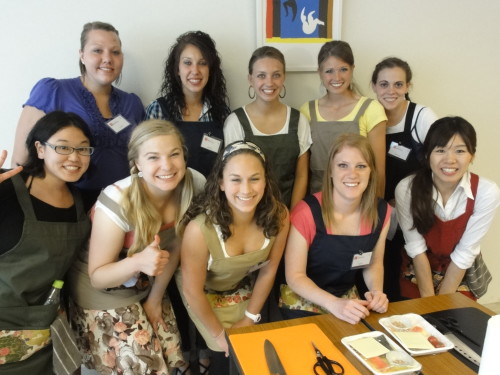
Last Saturday we had 17 participants from Southern Utah University join our cooking program!
The class started when the first 8 arrived in the morning but preparation for the class actually began the day before. We wanted the group to experience as much as possible in the class so we prepared the program so everyone can try making chirashizushi, karaage, tonjiru from the Basic Japanese Cooking class, and the bento from the Kyaraben Japanese Character Lunch Boxes class in less than 3 hours. Of course this includes time to eat and chat!
It was fantastic to see everyone serious about learning but not too serious that they forgot to have some fun, especially with the kyaraben bento boxes.
Although I know some struggled a little trying the Japanese-style mayonnaise and raw fish (which I can totally understand growing up in the States), everyone was quite good about trying everything. I always hope that everyone in our classes give these two ingredients a shot since the mayonnaise is different from what you find in certain countries and hopefully the raw fish is more fresh than what you find in your average Japanese restaurant outside of Japan, but no pressure! It’s just that I used to not be able to eat anything but now I can pretty much everything so I always want to share the joy that comes from giving things a try not just once, but a few more tries. Because you never know what you may end up liking!
The second group of 9 included the wonderful professor himself who was the one responsible for bringing his 14 students to study abroad and participate in our program. What an amazing person!
Lots of thanks of course too for thinking that our program will fit well with the student's studies on Japanese family life, culture, food, and nutrition.
Megumi and I are the ones teaching the class of course but because we always teach a diverse group of people, we are also learning from them every time. This time was especially meaningful to me personally because the students were from the US and they reminded me of myself 10 years ago. It was a wonderful feeling being able to share the Japanese side of my Japanese-American identity with them. Hopefully it will have some positive effect!
Last but not least, we must not forget to give recognition to the following two lovely ladies who assisted us for the day.
We must never forget Megumi’s mother who is always helping with the classes. She seems quite popular among our past participants!
And this is our special guest for the day, Megumi’s sister who helped us just for the day. We couldn’t have done it without them!
The small groups of two or three are great but there are many things to learn from these large groups too so hopefully we will get more opportunities like this again!
Note: we no longer conduct Nagomi Visit cooking classes but feel free to look for Nagomi Visit hosts who are interested in cooking with you by checking their profile pages. Nagomi Visits are not cooking classes but it will be an enjoyable experience like cooking with a friend.
2012-05-04
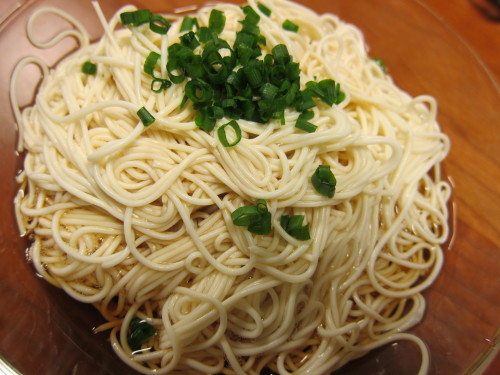
I think it was 4 years ago when I got hooked on cold tofu somen noodles. It is not a traditional Japanese dish but a product that was probably dreamed up by a company a few years ago and I guess has quite a bit of a fan base since grocery stores still sell it. Since normal cold somen noodles are a summer dish, these somen noodles made out of tofu also usually come out right before we hit the summer season. I use to eat it like a maniac because I loved both tofu and somen so this product seemed like a dream come true. Plus it was low in calories and I was trying to lose pounds and pounds of weight back then so this was perfect and it sure did work.
So now it is right before summer and the tofu somen are displayed nicely on the grocery store shelves. I was reminded of my love for this product and decided to give it another shot. I ate it with green onions, grated ginger, and broth with your basic Japanese ingredients like dashi, soy, and mirin like I would normally eat cold somen noodles. It tasted fine but something felt wrong.
It took me a bit to realize this but I think I’ve started to like the flavor of soy in real tofu so much that not being able to taste the soy enough in the tofu somen just didn’t seem right. So it wasn’t like the tofu somen noodles tasted bad but I think I just had to consider this product more of a new type of somen that happened to be made with tofu than a tofu product.
So I guess my taste buds have changed but I still think tofu somen noodles are a good healthy midnight snack. Much better than the homemade Oreo cheesecake leftovers (or may I say calorie overload?) I ate the other day! Yum but yikes!
2012-05-01
When I eat my standard Japanese steamed rice at home I usually have my jurokkokumai (十六穀米) which means rice with 16 grains. I have a huge stock of small packets with these 16 grain mixes I get from the supermarket. These individual packets have a long list of grains including foxtail millet, germinated brown rice, black rice, black soybean, amaranthus, sorghum, quinoa, azuki bean, black sesame, white sesame, adlay, red rice, proso millet, barley, corn, and Japanese barnyard millet, and I mixed them into my white rice. Apparently the grains have lots of fiber and is very good for you but I honestly just like it because it tastes good.
However, there are days when I do a little something different. Today my husband felt like takikomi gohan so I made this dashi and soy sauce based rice dish in my rice cooker. All I needed to do was make the base flavor for the rice with soy sauce, mirin (sweet rice wine), dashi stock, and salt, and today's ingredients happen to be chicken thighs, aburaage (deep fried tofu), carrots, shimeji mushrooms, and gobo (burdock) which I cut up into small pieces and placed over the rice to cook.
If you look around for takikomi gohan recipes on the internet, there are ones that use other types of mushrooms, use konnyaku, hijiki sea vegetables, among other ingredients but today I felt like having chicken thighs, aburaage, and gobo for sure so the above was just what I used. I normally like hijiki but if you buy good hijiki the flavor is quite strong so on a day when I wanted to really taste the chicken I decided not to put it in. I also see a few recipes that use sugar or some other sweetener but I usually like a more subtle sweetness so I replaced it with mirin. Lastly it was already past 8PM when I started cooking so I chose a shortcut and used granulated instant dashi instead of making homemade dashi.
When you make this dish, make sure you can find gobo where you live because the earthy taste that comes from this root is very distinct yet nice. Plus preparing it is fun since you use the sasagaki cutting style which literally means to cut something as fine as a bamboo leaf but basically you are cutting the burdock like you are sharpening a pencil with a knife. You can also find instructions on the internet on how to do this so give it a try!
2012-04-26
21
padding: 3rem 0 2.5rem;
max-width: 760px;
}
.intro-section p {
font-size: 17px;
color: var(--text-mid);
line-height: 1.7;
}
.story-section {
padding: 0 0 4.5rem;
}
.story-image-wrap {
margin: 0 0 2.5rem;
}
.story-image-wrap img {
display: block;
max-width: 100%;
height: auto;
}
.story-image-caption {
font-size: 13px;
color: var(--text-light);
margin-top: 0.6rem;
font-style: italic;
}
.story-body {
font-size: 16px;
color: var(--text-dark);
line-height: 1.9;
}
.story-body h2 {
font-size: clamp(1.15rem, 2.5vw, 1.4rem);
font-weight: 600;
color: var(--text-dark);
margin: 2.5rem 0 1.2rem;
}
.story-body p {
margin-bottom: 1.8rem;
}
.story-body p:last-child {
margin-bottom: 0;
}
.story-body ul {
margin: 0 0 1.8rem 1.3rem;
}
.story-body li {
margin-bottom: 0.6rem;
}
.story-body strong {
font-weight: 600;
}
.highlight {
border-bottom: 2px solid #E8835A;
padding-bottom: 1px;
}
.quote-block {
border-left: 3px solid var(--red);
padding: 1.5rem 1.8rem;
margin: 2.8rem 0;
background: var(--highlight-bg);
}
.quote-block p {
font-family: 'Cormorant Garamond', Georgia, serif;
font-size: 21px;
font-style: italic;
font-weight: 400;
color: var(--text-dark);
line-height: 1.65;
margin: 0;
}
.quote-block cite {
display: block;
font-size: 12px;
font-style: normal;
font-weight: 600;
letter-spacing: 0.12em;
text-transform: uppercase;
color: var(--red);
margin-top: 1rem;
}
/* FAQ */
.faq-section {
padding: 4rem 0;
border-top: 1px solid var(--border);
}
.faq-label {
font-size: 12px;
font-weight: 600;
letter-spacing: 0.22em;
text-transform: uppercase;
color: var(--red);
margin-bottom: 0.8rem;
}
.faq-title {
font-size: clamp(1.3rem, 3vw, 1.8rem);
font-weight: 600;
line-height: 1.3;
margin-bottom: 2rem;
color: var(--text-dark);
}
.faq-item {
margin-bottom: 1.8rem;
}
.faq-item:last-child {
margin-bottom: 0;
}
.faq-q {
font-size: 16px;
font-weight: 600;
color: var(--text-dark);
margin-bottom: 0.5rem;
}
.faq-a {
font-size: 16px;
color: var(--text-dark);
line-height: 1.85;
}
/* ABOUT */
.about-section {
padding: 4rem 0;
border-top: 1px solid var(--border);
}
.about-label {
font-size: 12px;
font-weight: 600;
letter-spacing: 0.22em;
text-transform: uppercase;
color: var(--red);
margin-bottom: 0.8rem;
}
.about-title {
font-size: clamp(1.3rem, 3vw, 1.8rem);
font-weight: 600;
line-height: 1.3;
margin-bottom: 2rem;
color: var(--text-dark);
}
.about-body {
font-size: 16px;
line-height: 1.9;
color: var(--text-dark);
margin-bottom: 1.5rem;
max-width: 720px;
}
.about-body strong { font-weight: 600; }
.about-body:last-of-type { margin-bottom: 0; }
/* CTA */
.cta-section {
padding: 4rem 0 3rem;
border-top: 1px solid var(--border);
}
.cta-title {
font-size: clamp(1.2rem, 3vw, 1.7rem);
font-weight: 600;
color: var(--text-dark);
line-height: 1.35;
margin-bottom: 1.2rem;
}
.cta-body {
font-size: 16px;
color: var(--text-mid);
line-height: 1.85;
margin-bottom: 2rem;
max-width: 560px;
}
.cta-btn {
display: inline-block;
background: var(--red);
color: #fff;
font-size: 12px;
font-weight: 600;
letter-spacing: 0.14em;
text-transform: uppercase;
padding: 15px 38px;
text-decoration: none;
white-space: nowrap;
transition: background 0.2s ease;
}
.cta-btn:hover { background: var(--red-dark); }
.footer-note {
padding: 2rem 0 1rem;
font-size: 13px;
color: var(--text-light);
border-top: 1px solid var(--border);
margin-top: 1rem;
}
@media (max-width: 600px) {
.story-section { padding: 0 0 3.5rem; }
.faq-section { padding: 3rem 0; }
.about-section { padding: 3rem 0; }
.cta-section { padding: 3rem 0 2rem; }
}
Spend a few days in a Japanese kitchen and you will start noticing things that never made the guidebooks: how rice is rinsed, how leftovers are wrapped, and yes, why a simple pack of sausages comes in two separate, slightly inflated bags. It looks strange. It feels like over-packaging. But there is a surprisingly good reason behind it.
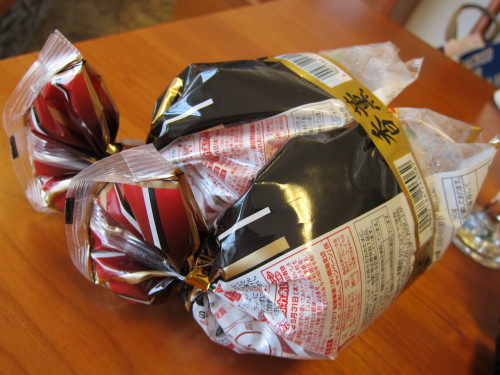
A typical pack of Japanese sausages: two bags, taped together, each one slightly puffed up with gas.
The Sausage Packaging That Confuses Every Visitor to Japan
If you have ever shopped at a supermarket in Japan, you have probably picked up a pack of sausages and wondered why it felt like two small balloons taped together. The cheaper sausages tend to come this way: stuffed loosely into a single inflated bag. The fancier ones, usually larger or flavored with herbs, are vacuum-sealed instead. But the everyday sausages that most households buy come in two separate inflated bags joined together as one product.
For anyone used to shrink-wrapped meat from a supermarket back home, this looks like classic Japanese over-packaging, the same instinct behind individually wrapped fruit or single-serving snack portions. But the two-bag sausage design is not about presentation. It is about food science.
Why Are Japanese Sausages Packed in Inflated Bags?
The bags are inflated with nitrogen gas, not air. Nitrogen is used because it does not react with the meat the way oxygen does. Oxygen is what causes fat to oxidize, color to fade, and bacteria to grow faster. By replacing the air inside the package with nitrogen, manufacturers slow down spoilage and help the sausages stay fresher for longer on the shelf.
This is also why the sausages are split into two separate bags rather than one large one. Most households do not eat an entire pack of sausages in a single meal. Once a bag is opened, the nitrogen barrier is gone and oxygen starts working on the contents immediately. By dividing the pack in two, only one bag needs to be opened at a time. The second bag stays sealed, still protected by nitrogen, ready for the next meal.
Why Not Just Vacuum-Pack Them Like Ham and Bacon?
This is where the size of the sausage matters. Japanese sausages, the kind found in bento boxes, breakfast plates, and stir-fries, are typically small and thin. A handful of them can fit comfortably inside a small inflated bag without losing their shape.
Larger products like ham, bacon, and thicker sausages cannot be packaged this way. If they were placed in an inflated bag, the lack of pressure would cause them to lose their shape, flatten, or bend. Vacuum packaging solves this by pressing the packaging tightly against the product, holding its form. So the rule of thumb is simple:
- Small sausages → nitrogen-filled bags, often in pairs, for shape protection and double freshness
- Larger sausages, ham, and bacon → vacuum-sealed, to maintain shape and density
Once you know this, the "balloon sausages" stop looking like wasteful packaging and start looking like a quietly clever piece of food engineering, designed around how Japanese households actually cook and eat.
A Small Detail That Says a Lot About Japan
Details like this rarely show up in travel guides, because they are not landmarks or experiences you can book a ticket for. They are the kind of thing you only notice when you are standing in someone's kitchen, helping unpack the shopping, or reaching into a refrigerator that is not your own.
"It's the small things, like opening someone's fridge or helping cook dinner, that end up being the most memorable part of the trip."
— A common reflection from Borderless Visit guests
This is exactly the kind of everyday curiosity that comes alive during a Japanese home dining experience. When you sit down to a meal cooked by a Japanese family, you are not just eating, you are seeing how a household actually runs: what's in the fridge, how meals are prepared, and why certain products look the way they do.
Frequently Asked Questions
Quick Answers About Japanese Sausage Packaging
Why are Japanese sausages sold in two bags?
Japanese sausages are often divided into two separate inflated bags, taped together as one product, so that only one bag needs to be opened at a time. The unopened bag stays protected by nitrogen gas, keeping the sausages fresh until the next meal.
What gas is used in Japanese sausage packaging?
The bags are filled with nitrogen, an inert gas that does not cause the oxidation, discoloration, or bacterial growth that oxygen does. This is a common food preservation technique called modified atmosphere packaging.
Why aren't all Japanese meat products packaged this way?
Inflated nitrogen bags work well for small items like thin sausages, which keep their shape without pressure. Larger products such as ham, bacon, and thick sausages are vacuum-sealed instead, since vacuum packaging presses against the product and helps it hold its shape.
Is this considered over-packaging in Japan?
It can look that way at first glance, especially to visitors used to single-bag packaging elsewhere. However, the two-bag design serves a practical purpose: extending freshness and reducing food waste by keeping unopened portions protected.
About Borderless Visit
More Than a Meal. A Genuine Connection.
Borderless Visit connects travelers with Japanese host families for an evening of authentic Japanese home dining. Not a restaurant, not a tour, but a real meal in a real home with people who are genuinely curious about you.
Every Japanese family dinner through Borderless Visit is different. Some involve kimono dressing and elaborate spreads. Others are quieter, more intimate: a kitchen conversation and a home-cooked meal made with everyday ingredients, like the very sausages in this article.
For travelers looking for an authentic Japan experience beyond the standard itinerary, dining with a Japanese family offers something no guidebook can: a firsthand look at the small, everyday details that make daily life in Japan so different, and so interesting.
Curious About Everyday Life in Japan?
The best discoveries often happen in someone's kitchen. Book a Borderless Visit and experience Japanese home cooking for yourself.
Book Your Experience
2012-04-25
If you like cooking like me, I think you MUST visit Kappa-bashi(合羽橋)during your stay in Tokyo.
Kappa-bashi is the street and there are so many shops which provides cooking and kitchen tools such as plates, paper thing, pot, knives, cookie templates, chopstics and so on, I love this place very much!
There is not only for the consumars but also professionals like chef or manager of restaurant it means sometimes you can find and get staffs cheaper than the other place. When I go to Kappa-bashi, usually I need more than three hours to take a look for all the shops I'm interested in because there are tons of nice goods for cooking lovers.
I have thought that I want to introduce this place to all the guest of Nagomi Kitchen, but I have always forgot to take pictures because I always concentlate to my own shopping :D
But few weeks ago, my boyfriend's mother and aunt visited us from Denmark and we took them to Kappa-bashi so finally now I can introduce you my favorite place with many pics!
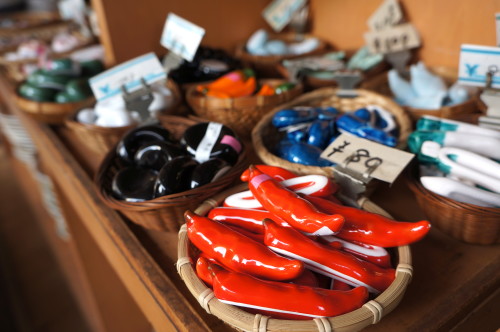
Many kind of design of tiny plates, it called Mamezara in Japanese. The price is just around 100-300 yen.
Tea pot, price is about 1,000 yen. You can find many kind of green tea easily at the supermarket and just put them into this pot with hot water.
Cups, price from 500 yen to 1,000 yen.
Nambu Ironware, it's the Japanese traditional craft. Looks nice!
If you visit Takayama during your trip in Japan, maybe you can find this one at there when you served original dish at Takayama, "Hooba-Miso".
Steam cooker.
Kappa-bashi is also famous for the food sample.
I will show you something I got at Kappa-bashi.
Kappa-bashi is nearby Asakusa (about 10 minutes on foot) so you can schedule to visit this wonderful place at the same day as Asakusa. Good luck for your shopping!
2012-04-20
A few weeks ago some nice folks gave me fresh uni or sea urchin since they just came from the Tsukiji fish market. This was definitely a very lovely gesture but also very unexpected. Because honestly, the only time I actually cut an uni open was when I found a bunch somewhere in the beaches of Mexico I think. Since coming to Japan I’ve been spoiled with the affordable fresh but already prepared uni in the stores so I just never had to go through the whole preparation process. It would have been great to slice these suckers open on the spot and offer them a piece too but I seriously was not ready.
When I was finally ready for the challenge, I was too excited to wait for any of my kitchen savvy friends to respond to my dilemma that I decided to rely on YouTube. It has saved us from having to pay someone to install our built-in electric cooktop because a video tutorial showed us how to do it ourselves among other things so I thought it was the perfect solution. Sure enough there were a bunch of Japanese (and English which I found afterwards) videos on how to properly scoop out the uni.
Most of the videos tell similar instructions where you either use a knife or some other tool that will help crack open the uni and then you are to pull out the black seaweed that is covering the lovely orange jewels. But the one video I found later on said that you could actually eat that black seaweed separately so will have to try that next time.
So the lesson for today is, be like me and use YouTube to solve all your problems! Or at least all your Japanese food related problems because it's sometimes easier to understand than written recipes.
And yes of course, if it weren't for the lovely folks that gave me these uni in the first place, I wouldn't have had this yummy experience. Arigato very much and next time, I will be prepared for sure!
2012-04-10
I'm usually Alisa Sanada co-organizer for Nagomi Kitchen but last Sunday I was host to a lovely family from Montreal and a very enthusiastic traveler from Moscow. I made kawarasoba which is a dish we always love to make when we have guests visiting Japan.
This dish which literally means roof tile soba, is a Shimonoseki specialty. Although Shimonoseki is famous for blowfish worldwide, not many people actually end up visiting the area. Dishes such as takoyaki and okonomiyaki from the Kansai area are quite famous and if visitors have more time they might be exposed to dishes that are famous in Hokkaido or Okinawa, but everything else in between is usually a blur. Making kawarasoba is just my way of introducing at least one of the underrepresented areas in Japan.
If you happen to end up trying kawarasoba at a restaurant, this is what it would look like. Of course it looks pretty with the noodles actually on the roof tiles and it sure is good, but like the houtou noodles I ate nabe style a few weeks ago, it's great to eat these regional dishes at someone's home since it makes the dish more accessible. If you eat the kawarasoba with us, you can obviously tell that you can use an electric griddle instead of heating up a roof tile, and use normal buckwheat noodles or udon noodles as a substitute for the green tea noodles since they are sometimes difficult to find.
Try it out at home or come see us when you come to Japan!
Note: Nagomi Kitchen has changed to Nagomi Visit. See more information about our current program on our site.
2012-04-08
When you look at the Nagomi Kitchen site you might only see the two of us, Megumi Kusunoki and myself, Alisa Sanada, on the about us page, but we are actually supported by many amazing advisors. Among these wonderful advisors is Megumi Kusunoki’s mother. If you are a past participant in one of our cooking programs, then you might have met her. She’s the one with the camera snapping away making you feel like a superstar during our sessions. And if you are going to be participating in the near future, make sure to get all your Japanese food and Bali scuba diving questions ready because she sure knows a lot about both and is ready to share.
She is from Yamanashi Prefecture, most famous for Mount Fuji. However, in my eyes it’s the land of the yummy regional dish houtou. It's a flat udon noodle dish with vegetables in a miso soup broth that is normally eaten at a restaurant if you are not from the region. But of course the locals eat it at their homes and mmm-hmm it sure is delicious!
I had the pleasure to try her homemade houtou, which was my first one outside of a restaurant. What I liked about it most was the fact that we were eating it nabe hot pot style instead of each person with an individual bowl. It was great seeing the soup get thicker and thicker because you cook the noodles still covered with flour unlike other noodle dishes where you need to pre-cook using another pot. That combined with the broth that comes from the ingredients like chicken, kabocha pumpkin, onions, fried tofu, carrots, mushrooms, daikon radish and of course miso, mmm-hmm is all I can keep on saying! Even if you can’t get a hold of houtou noodles, at least try making it with udon noodles. You will understand how great miso is, and how it is not just for miso soup!
2012-04-06
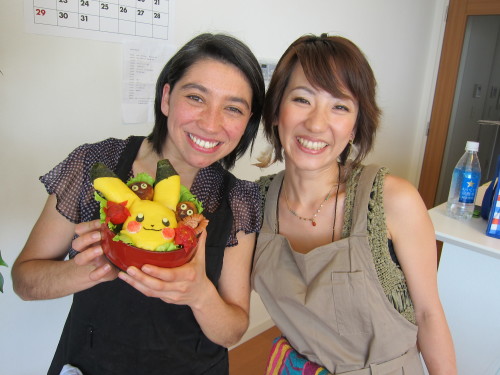
3 guests joined our Kyaraben lesson yesterday and made a Picachu bento box.
Olivia and Dylan from Canada, it was their first day in Japan of their two weeks journey. And Rex from Hong Kong, it was the last day for his second trip to Japan. They have a big interesting to making Kyaraben. (Character bento.)
Olivia wondered that "Is threre any restaurant where people can eat Kyaraben in Japan?" The answer is no, but I think it's a very nice idea if people can eat Kyaraben at restaurant.
But now, Olivia, Dylan and Rex became a Kyaraben master so they don't have to go to Kyaraben restaurant!
"It's first time to having a lot of fun with food" said Olivia when she arranging her own Picachu on her bento box as final step. I was very glad to hear it.
Thank you Olivia, Dylan and Rex!
Note: we no longer conduct Nagomi Kitchen cooking classes but feel free to look for Nagomi Visit hosts who are interested in cooking with you by checking their profile pages. Nagomi Visits are not cooking classes but it will be an enjoyable experience like cooking with a friend.
2012-03-29
Last Sunday we had a very cool guest from the Canary Islands that requested that we do a kyaraben class where we make the Futurama character Nibbler instead of our usual characters. Apparently her nephew loves the character so she came to train with us so she could make the bento back home.
We used the same ingredients as the usual kyaraben we make in our classes but because the parts for Nibbler were more complex compared to our usual class, it was a bit more of a challenge.
However, our guest worked her magic and the end result was amazing! I’m honestly not sure if I could have the same patience she had when making the very small parts, especially for the eyes, but she did it!
Actually all during the session we had a tv crew taping on and off and at the end we had a short interview.
Megumi was interviewed too but it seemed like the camera was making everyone laugh instead of talk. But I guess that's okay.
If any of you would like to try something out for our kyaraben class, let us know and we will see what we can do. Just be ready for the challenge!
Note: we no longer conduct Nagomi Kitchen cooking classes but feel free to look for Nagomi Visit hosts who are interested in cooking with you by checking their profile pages. Nagomi Visits are not cooking classes but it will be an enjoyable experience like cooking with a friend.