🎉 Nagomi Visit has a new name: Borderless Visit. Our mission remains the same, connecting people through home-cooked meals and genuine encounters. Learn more

Blog

Kyaraben request

2012-03-10

Before I started Nagomi Kitchen cooking lesson, I was thinking a lot about the lesson menus.

"What menu will be fun for tourist to experience Japanese cooking during their stay in Japan?" "How can I provide the enjoyable cooking time to them?"

And when I was considering it, I believed that making kyaraben will be a one of fun thing for almost participant because I have enjoyed by myself very much. (To be honest I have never cook kyaraben for a real lunchbox though but I knew taking photos of own creation was really exciting!)

So, I started kyaraben lesson from last year and many participants have already created their own kyaraben.

Nagomi Kitchen cooking lesson

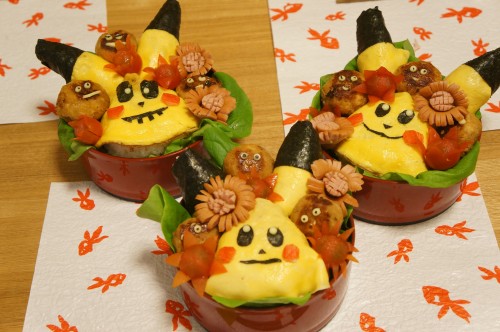
And few days ago, I received a request from guest who booked our kyaraben lesson for end of this month. She want to create different kyaraben. Do you know it?

Actually it was first time for me to receive this kind of request, (in addition I have never seen this character before!) but I tried to make it. How do you think about this kyaraben?

Nagomi Kitchen cooking lesson

I will cook it together with guest on end of March, and will pass the recipe for it.

I love try to make new kyaraben, so if you want to make your favorite character with us, please let me know when you booking.

Of course I want to try but I guess there is some character which is completely impossible to create as kyaraben so I will inform you if I can do that or not after receiving a request!

Note: we no longer conduct Nagomi Kitchen cooking classes but feel free to look for Nagomi Visit hosts who are interested in cooking with you by checking their profile pages. Nagomi Visits are not cooking classes but it will be an enjoyable experience like cooking with a friend.

Just give natto another try

2012-03-09

Just give natto another try

When it comes to the topic of Japanese food with travelers, I know everyone loves to talk about the fermented soybean dish natto, since it is the quintessential weird food of Japan with it’s gooeyness and smelliness. But I am honestly tired of hearing Japanese people always asking non-Japanese travelers if they have tried natto during their travels in Japan and if they liked it or not. I mean doesn’t every Japanese person already know that even some Japanese people born and raised in Japan can dislike natto? And I get more annoyed when people go bonkers with disbelief when the traveler actually does like it. Seriously, I wish people would come up with other things to ask like have you tried shirako fish milt, because although it might sound disgusting it sure is terrific!

Well, that said, I never was much of a fan of natto while growing up as a Japanese-American in Texas. Although I still don’t go out of my way to buy natto at my local supermarket in Tokyo, that doesn’t mean I haven’t grown to like it. When I first tried good natto, it was when my Japanese aunt introduced me to natto made in Ibaraki prefecture. I’m still no expert at this point when it comes to natto specifics, but I could really tell the difference because the flavors from the soybean itself was stronger than the pungent smell you often hear about making the natto quite pleasant to eat.

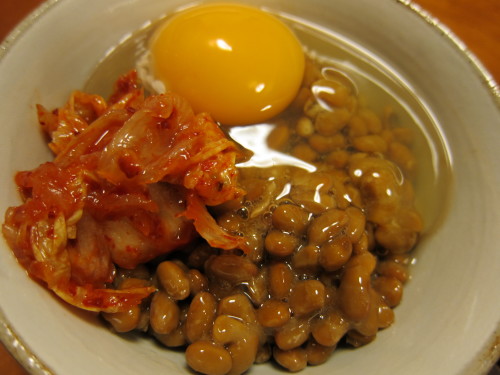
The way you eat the natto might also change your perspective. Depending on how much more sliminess you can embrace, you can mix and match raw egg, yamaimo mountain yam, okra, green onions, cucumbers, dried seaweed, shiso leaves or even kimchi and cheese. Natto maki rolls are very common but you can also find natto omelets, tempura, and even pasta.

So for those who have already given up on natto on your first try, it might just be that you haven’t found your best match. There are so many different kinds of natto from different regions, brands, and well even the size of the natto will affect the taste. Your local supermarket might have a good selection but make sure to check out a nearby depachika (the basemet floor of a large department store) or other specialty food stores you may stumble upon while you wonder the streets of Japan. Hopefully you will finally find your best match.

Kyaraben: Japanese character lunch box lesson March 4th

2012-03-05

Nagomi Kitchen Kyaraben Cooking Lesson

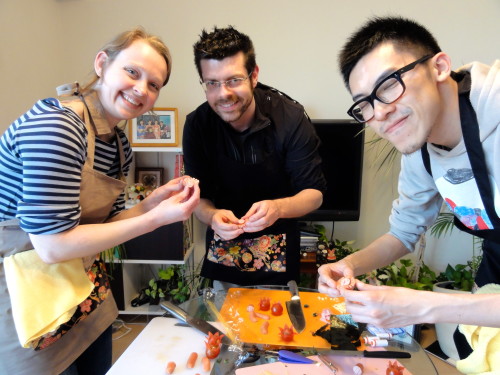
I have to be honest. I was always in awe of the pictures circulating the internet of bento boxes decorated like album covers like Radiohead and Lady Gaga, but was never a loyal follower of all things kyaraben before participating in the Nagomi Kitchen Kyaraben Cooking Lesson. It just looked too time consuming! However after going through the steps of making the head and ears, little tofu ball faces, and cherry tomato and sausage flowers with our charming guest from Malaysia last Sunday, although I might not make these character bento boxes everyday, I now know that I actually like making them.

Nagomi Kitchen Kyaraben Cooking Lesson

The goal of the class is of course to make this kyaraben but you will be introduced to recipes and techniques that can be used for normal bento making when you are too busy to go through all the kyaraben making steps. The tofu balls are a great example of some good basic bento side dishes.

Nagomi Kitchen Kyaraben Cooking Lesson

Bento making in general has become quite popular around the world so we’re hoping to recruit more here at Nagomi Kitchen!

Note: we no longer conduct Nagomi Kitchen cooking classes but feel free to look for Nagomi Visit hosts who are interested in cooking with you by checking their profile pages. Nagomi Visits are not cooking classes but it will be an enjoyable experience like cooking with a friend.

Basic Japanese Cooking lesson Feb. 23rd

2012-02-25

Nagomi Visit home cooking

This Thursday we had a lovely guest from the US and his father participate in our Basic Japanese Cooking lesson. They were such fun and enthusiastic guests that I, myself, very much enjoyed my time with them.

Nagomi Visit home cooking

It was fantastic seeing families like them really trying to dig deep into Japanese culture during their short stay in Japan. Especially the father, who although it was his first time in Asia, he really made an effort to learn Japanese by listening to language CDs. Honestly I’m never usually that easily impressed by people being able to speak Japanese but this time it was special since every now and then he would blurt out a Japanese word or phrase he learned and it wasn’t just once or twice! Subarashii! Very good.

“Food was great and the staff exceptional. I had a lot of fun and was very comfortable. If I am ever in Japan again, I will sign up again.” we were told! Hopefully their Home Visit experience, which they booked at the same time, will be as good or maybe even better?

Nagomi Visit home cooking

Recently we have been receiving a lot of requests where the same people participate in both the cooking and Home Visit programs during their stays so we’re working hard right now at Nagomi Kitchen to increase the number of host families so more people will be able to participate in both programs. Definitely great to hear.

Nagomi Visit home cooking

As a Japanese-American, I'm always glad when people are interested in learning about Japanese culture since I feel like they are learning about a part of my identity. This is especially true of course when visitors are from the US so hopefully see you next time at Nagomi Kitchen! Matane!

Note: we no longer conduct Nagomi Kitchen cooking classes but feel free to look for Nagomi Visit hosts who are interested in cooking with you by checking their profile pages. Nagomi Visits are not cooking classes but it will be an enjoyable experience like cooking with a friend.

Bacon...it's what's for dinner

2012-02-22

Nagomi Visit home cooking

Today I made a Japanese style soup with bacon for dinner. I suppose if I still were in the States I might have made the soup with potatoes, cheese, leeks, or beans but this time since I am in Japan using Japanese bacon, the soup had a light chicken broth base with mizuna, enoki mushrooms, and green onions.

I suppose everyone has their opinion of Japanese bacon depending on where they come from. Coming from the States you might be surprised at how it tastes more like ham. But as long as you know how to cook with it, I’m hoping you will crave more of these new set of flavors rather than just longing for whatever is back home.

Using bacon with ingredients like asparagus, spinach, potatoes, and cheese is quite common in Japan but I love it when I find bacon recipes that really have an obvious Japanese twist to it like bacon and nanohana blossoms pasta. You can either make a simple version with just basic flavors like olive oil, garlic, red pepper, and of course salt and pepper, but a cream sauce would work well too. Add any sort of Japanese mushroom you find at the supermarket that day that is cheap like maitake mushrooms and voila!

I honestly cannot imagine my Japanese mother making this dish at home since it definitely is the younger generation that has incorporated this new ingredient into their diet for better or for worse. However, it is not uncommon for quick and easy East meets West types of dishes like these to appear in a modern Japanese home cooked meal.

So although it is definitely good to learn about purely Japanese ingredients, sometimes it is fun to learn how these perhaps more familiar ingredients are used in Japanese home cooked meals.

Make sure to ask us about seasonal vegetables like nanohana during our Nagomi Kitchen cooking lessons because spring is coming to Japan and it’s definitely an exciting time for food here!

Note: we no longer conduct Nagomi Kitchen cooking classes but feel free to look for Nagomi Visit hosts who are interested in cooking with you by checking their profile pages. Nagomi Visits are not cooking classes but it will be an enjoyable experience like cooking with a friend.

Bonito Nagomi Kitchen!

2012-02-18

Today we held Learn basic Japanese cooking lesson with four guests.

Nagomi Kitchen on EL INTERMEDIO

Deanna from France, she live in Japan for just 2 month and her friend in France booked this lesson as a gift for Deanna. We are really glad that Nagomi Kitchen was chosen as a gift.

In addition the TV crew Pablo, Pedro and Marcos from Spain joined our cooking lesson to shoot their program, EL INTERMEDIO (Channel: LA SEXTA)

Nagomi Kitchen on EL INTERMEDIO

So, today's lesson was conducted in various languages including French, Spanish, Japanese and of course English.

Before cooking, I told them about the Japanese soup stock, Dashi. It's made from edible kelp and dried bonito. Then Pablo said "Bonito? It's mean beautiful in Spanish!" I did not know about that but it's interesting the same word means fish and beautiful.

Nagomi Kitchen on EL INTERMEDIO

I received kind comments from them about their impressions of Nagomi Kitchen's cooking lesson.

From Pedro: The kitchen is very nice. Very spacious, charm, lovely place. Megumi is a very kind and lovely person and her mum is also very kind. They are both very funny.

From Pablo: So friendly people and so tasty food that I want to settle in this kitchen forever!

From Deanna: Really friendly, food is really good! Thanks a lot.

Nagomi Kitchen on EL INTERMEDIO

We also enjoyed today's lesson. I'm looking forward to watch today's lesson on Spanish TV program at the end of March and believe Deanna will be able to cook today's menu for her friends when she back home.

Note: we no longer conduct Nagomi Kitchen cooking classes but feel free to look for Nagomi Visit hosts who are interested in cooking with you by checking their profile pages. Nagomi Visits are not cooking classes but it will be an enjoyable experience like cooking with a friend.

More than just Kikkoman

2012-02-16

More than just Kikkoman

It was two years ago when I first realized the amazing variety of soy sauce brands that were available in Japan. I attended a soy sauce tasting event similar to a wine tasting where you would learn about the people and regions where the soy sauce was made and how best to use it in your cooking. I had seen the extensive selection of soy sauce in my local supermarket in Tokyo before attending this event but actually sampling the different soy sauce and tasting the difference, I finally started to view individual soy sauce like microbrews and wanted to continue trying more.


Discovering these differences in flavors within basic Japanese ingredients such as soy sauce has been an exciting process for me having grown up in a Japanese family living in Texas where Kikkoman soy sauce was the most accessible product out there. Although there is nothing wrong with sticking to Kikkoman since it is the most popular Japanese soy sauce around, it is great to know that I have other options making Japanese cooking that much more exciting to experiment with.


While there are many other soy sauce brands around the world, it would definitely be nice if everyone could try more Japan made soy sauces if they are looking for something to use in their Japanese cooking. I’ve also been trying a variety of Japanese mirin, dashi, and even salts and sugars and it is exciting how each distinct brand has a different nuanced flavor making my food come out different every time. So make sure to visit a supermarket next time you come to Japan and if you have any questions about products that are sold in the supermarket feel free to ask us at Nagomi Kitchen.

Miso soup beyond tofu

2012-02-15

Miso soup beyond tofu

Yesterday I went to a friends house and was surprised that she served miso soup with fresh ginger. Being a fan of all things ginger, I searched around on the internet both in Japanese and English for similar recipes. Although it wasn’t one of the most popular ingredients when it comes to miso soup, there seemed to be quite a few fans out there that liked it most during the wintertime to warm up. Seemed like a logical combination but I guess it just never crossed my mind to try it out.

It’s little discoveries like these that make miso soup exciting. A soup that seems so simple and straight forward has so much potential.

Miso soup is a staple menu in Japanese restaurant’s worldwide but I always feel that there is something lacking in them. Yes there are restaurants that get it right of course, but often times it just tastes like hot water with just miso and no depth. But I think what makes them less exciting is that there is not much variety when it comes to the actual ingredients inside the miso soup. It’s always tiny pieces of tofu, wakame seaweed, and maybe some green onions.

But don’t get me wrong, having tofu and wakame is not the problem. It’s the most basic yet most popular ingredient for miso soup. It’s just that even if you are just making this basic miso soup, I feel like not many people realize there is still a lot of room for creativity. You can just start from using different types of tofu. Of course you can choose between the basic hard or soft tofu but different brands have different flavors, especially fresh tofu, so it’s best to try all of them out. You can also cut the tofu into small pieces or large depending on what you put in with the tofu. There is also of course the option of using different dashi soup stock.

I suppose its best to make your own dashi from scratch but for everyday miso soup I use an ago flying fish dashi packet that looks like a tea bag because I personally like the more nuanced flavors that come from this dashi than when I use the popular Ajinomoto Hondashi. But that doesn’t mean you can’t make a pretty good miso soup with Hondashi so I don’t want people to knock it since it is the most accessible instant dashi out there. I think the key is to make sure that the flavors from your ingredients become part of the broth, adding more depth. That’s where the ingredients play a big role in making the flavor in your miso soup unique.

Besides tofu, I like potatoes in my miso soup with wakame but my husband is more of a daikon radish or taro fan which makes the soup base sweeter. Onions and cabbage are also options that make the soup base sweeter. An alternative to normal tofu would be fried tofu which is less oily than it sounds so it is one of my favorites. There are also all sorts of mushrooms in Japan so whichever one is the cheapest on that day usually ends up in our miso soups.

The tonjiru pork base miso soup that is part of the Nagomi Kitchen Japanese basic cooking class menu, although the dish has it’s own name, it really is a variation of miso soup. Since tonjiru has a lot of ingredients in it, we’re hoping it will help people to taste how all these ingredients blend with the miso, to get a sense of the potential miso soup has beyond your normal tofu, wakame, and green onion combination.

Even after you’ve done making the miso soup, there is also the option of putting a dash of shichimi chilli pepper just before you eat if you’re a fan of spice like me. So as you can tell, the combinations are endless so next time you are craving some miso soup, try these options out to break away from your normal miso soup cycle. Or if you are planning on joining us at Nagomi Kitchen, feel free to ask us questions because that's what we're here for!

How to make carrot flower

2012-01-16

This is the simmered vegetables which called as Nimono(煮物)in Japanese.

How to make carrot flower

Simmer carrot, lotus root, “Konnyaku” and any other vegetables with soy sauce, mirin and Sake. Sometimes we add the chicken in it as well. The taste of these kind of Nimono depends on each home.

Do you want to try making this carrot flower? Check the video below you can find how to make it. (Though it's in Japanese, but you can understand by just watch it.)

Make Home-made Takoyaki at your Nagomi Visit

2012-01-09

Takoyaki is a Japanese wheat flour-based snack filled with diced octopus.

Home-made Nagomi Visit Takoyaki

Although you can eat it at food stalls especially in the Osaka area, at a Nagomi Visit you will be able to make home-made ones.

Home-made Nagomi Visit Takoyaki

Mix flour, eggs and water (sometimes use dashi stock) then fry it in the special pan, put the boiled octopus and keep turning them until they are round shapes. Place it on plate, and pour the Takoyaki sauce, mayonnaise, seaweed powder and bonito flakes.

Home-made Nagomi Visit Takoyaki

Nagomi Visit is a great opportunity to discover regional dishes and of course interesting people all across Japan.

Home-made Nagomi Visit Takoyaki